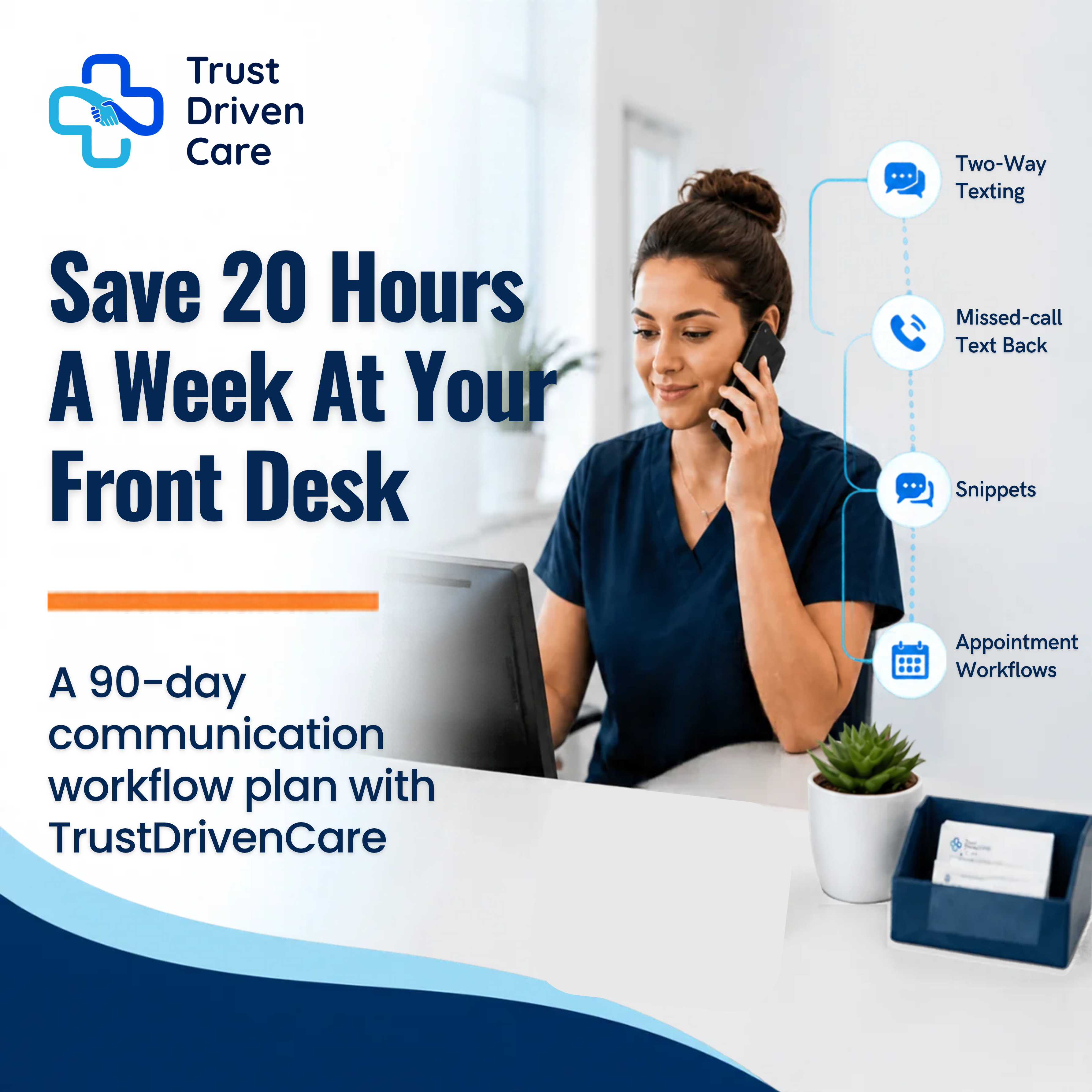
How to Save 20 Hours a Week at Your Front Desk Using TrustDrivenCare
How to Save 20 Hours a Week at Your Front Desk Within 90 Days Using TrustDrivenCare
Your front desk could be spending hours every week answering the same questions, returning missed calls, sending appointment instructions, and following up with patients. With the right communication systems, you can automate much of that work. TrustDrivenCare helps clinics use two-way texting, missed call text back, pre-written messages, and appointment-based workflows to save time while keeping patient communication personal.
Where Is Your Front Desk Spending Its Time?
In many busy clinics, a significant amount of front desk time goes toward repetitive administrative tasks rather than helping patients and supporting daily clinic operations.
Think about it:
Phone tag: Chasing patients across multiple calls and days just to get a response.
Chasing no-shows: Trying to remember who missed an appointment and following up one person at a time.
Repetitive questions: Answering the same questions about insurance, office hours, parking, and availability over and over.
Manual reminders: Sending appointment reminders, rebooking messages, and follow-ups by hand.
Every minute spent repeating these tasks is time your team could spend helping patients and supporting your clinic's daily operations. These hours don't have to be part of running a clinic. Much of this work comes down to the systems you have in place.
TrustDrivenCare helps reduce this workload through two-way texting, automated missed call responses, pre-written messages (Snippets), and appointment-based workflows.
Instead of managing every conversation manually, your team can spend less time on repetitive admin work and more time focusing on patients. Your team doesn't need more work. They need better systems to handle it.
Here are four workflows that can help you get there.
1. Use Two-Way Texting to Handle More Patient Conversations
Phone calls require your admin to stop what they're doing and focus on one person at a time. Texting gives your team more flexibility. They can respond to one patient, move to another conversation, and return to the first without putting anyone on hold.
Think about the questions your clinic receives every day:
What are your office hours?
Do you accept my insurance?
Are you open on Saturdays?
Do you have any appointments available next week?
Where should I park?
Should I still come in if I'm running late?
These questions matter, but they don't always require a phone conversation.
TrustDrivenCare's Two-Way Texting lets your team manage multiple patient conversations throughout the day without constantly stopping to answer or return calls. They can respond to one patient, move to another conversation, and follow up when needed.
The takeaway: Your team can handle more patient conversations in less time while staying focused on the people in front of them.
2. Turn Missed Calls Into Opportunities With Automatic Text Back
When a potential patient calls your clinic, they're often ready to take the next step. But if your front desk is busy helping another patient, that call can go unanswered, and the person may simply call another clinic.
TrustDrivenCare's Missed Call Text Back automatically sends a text when your clinic can't answer a call. It acknowledges the caller, opens a conversation, and gives your team a chance to respond when available.
For example:
“Hi! This is [Clinic Name]. Sorry we missed your call. Our team may be helping another patient right now. How can we help you?”
Your team can answer questions, arrange a callback, or share your Jane App™ booking link when appropriate.
The takeaway: You don't have to answer every call immediately. You need a system that acknowledges patients and keeps the conversation going until your team can respond.
3. Create Pre-Written Messages for Questions Your Team Answers Every Day
How much time does your front desk spend typing the same answers every day?
Questions about office hours, insurance, cancellations, parking, and appointment instructions come up repeatedly. Your team shouldn't have to write the same responses from scratch every time.
TrustDrivenCare Snippets let you save frequently used messages and send them in just a few clicks.
You can organize snippets by provider, treatment type, or situation so your team knows exactly what to send. They're also helpful when training new front desk employees because they have ready-to-use responses that follow your clinic's communication standards.
But pre-written doesn't mean impersonal.
A good snippet can handle 80% to 90% of the message. Your admin can add personal details before sending it to make the conversation feel natural.
The takeaway: Your team spends less time typing, communicates more consistently, and gives patients clear, personalized answers without starting every message from scratch.
4. Automate Appointment-Based Workflows Before and After Visits
Appointment reminders tell patients when to show up. But do they tell patients what to expect?
A new patient may still wonder what to wear, where to park, what to bring, or what will happen during their first visit. Your team often ends up answering these questions manually.
TrustDrivenCare's Jane App™ integration lets you automate communication based on appointment details, so patients receive relevant messages without your admin having to send each one manually.
For example:
When an appointment is booked:
Send a welcome message introducing your clinic.
Share a short video from the provider they'll be seeing.
Include directions and a picture of your clinic.
Before the appointment:
Send instructions about what to wear or bring.
Share preparation details specific to the appointment or treatment.
Address common questions to help patients feel prepared.
After the appointment:
Send a personalized check-in from their provider.
Share follow-up instructions or educational information.
Ask how they're doing after their visit.
These workflows can be customized based on the provider, appointment type, or treatment.
The takeaway: Your team spends less time remembering who needs a message and when to send it. Patients get timely, relevant communication that helps them feel prepared, supported, and more confident in their care.
How Much Time Could Your Clinic Actually Save?
The amount of time your clinic can save depends on how your team currently handles patient communication, how many messages and calls you receive, and which tasks you automate.
But consider what saving 20 hours a week could mean.
If your admin time costs $20 per hour, freeing up 20 hours each week represents $400 in staff time, or approximately $1,600 over four weeks.
That's time your team could spend helping patients, managing appointments, and keeping daily operations running smoothly instead of repeating the same administrative tasks.
The first step is to find out where that time is going.
BOOK A DEMO
How to Start Saving Time Within 90 Days
You don't need to change every process at once. Start by identifying the tasks your team repeats most often, then work on improving one area at a time.
Here's a practical plan your clinic can follow:
Days 1–30: Identify and organize repetitive tasks
Ask your front desk team to track the calls, texts, and follow-ups they handle each day.
Identify the questions patients ask most often.
Set up Two-Way Texting and Missed Call Text Back.
Create your first 15–20 Snippets for common patient questions.
Days 31–60: Improve how your team communicates
Review which Snippets your team uses most often.
Adjust responses to make sure they sound natural and personal.
Identify the questions new patients commonly ask before their first visit.
Plan appointment-based messages for different providers and appointment types.
Days 61–90: Automate and review your workflows
Set up welcome messages and provider introductions.
Create appropriate pre-visit and post-visit follow-ups.
Review which communication tasks your team still handles manually.
Compare the time spent on repetitive tasks with your original tracking.
At the end of 90 days, review the results with your front desk team. Look at what takes less time, which patient questions are easier to manage, and where another workflow could help.
You can then use those findings to decide what to improve next.
Give Your Front Desk More Time for What Matters
Your front desk plays an important role in your clinic. They're often the first people patients speak with and the ones helping keep the day running smoothly.
But they shouldn't have to remember every follow-up, manually type every response, or spend the entire day playing phone tag.
The right systems make it easier to stay connected with patients while reducing the repetitive work your team handles every day.
TrustDrivenCare brings Two-Way Texting, Missed Call Text Back, Snippets, and appointment-based automations together. With its Jane App™ integration, your clinic can use appointment information to send timely, relevant communication without relying on your staff to manage every message manually.
Start by reviewing your front desk team's daily tasks. Find the three communication tasks that take up the most time, then decide which one you can simplify or automate first.
Schedule a demo to see how you can simplify patient communication and build workflows that support your team.
BOOK A DEMO
Watch the Video
In this video, the team explains how to use patient lists and automated sequences to stay connected while keeping the communication personal.
Start With the Person, Not the Automation
The best nurture messages start with a simple question:
“Who am I talking to, and what would actually help them right now?”
For example, you might have patients who have had chiropractic care but have never tried massage. Instead of sending the same message to everyone, you can create a group and send helpful information about how massage may support their care.
You can do the same with other services, new leads, inactive patients, or patients who have already booked.
A Real-Life Experience: From Lead to Patient
Dr. Amanda shared a real-life experience from her clinic that shows how consistent, helpful communication can turn an interested lead into a patient.
A potential patient filled out their online booking form but decided not to book right away. Instead of letting that lead disappear, the clinic continued sending helpful emails about what made their practice different and how they could help.
About a month later, the person was ready and booked an appointment through Jane™.
But the nurture did not stop there.
Once the appointment was booked, the communication changed. The patient received information about what to expect, how to find the clinic, and what their first few weeks of care might look like. The patient later told the clinic that she loved the process because she felt informed and knew what to expect.
That is the real value of nurture sequences.
You are not trying to convince someone to book before they are ready. You are staying helpful until they are ready, then changing the conversation as they move through their care.
Let TDC Handle the Repeatable Work
A patient may move through several stages:
Lead → New Patient → Ongoing Care → Follow-Up
Each stage can have different communication.
TDC can use information from Jane™ to help trigger the right sequence at the right time, so your team does not have to remember every step or manually update every patient. The technology handles the repeatable work. Your team keeps the human connection.
Make Automation Feel Human
Automation does not mean every message needs to sound automated. Keep the message relevant to the person, use their name when appropriate, and give them information that actually helps them move forward.
The goal is not to send more messages. The goal is to send the right message at the right time.
BOOK A DEMO
Try This Today
You do not need to change everything at once.
1. Clean up one TDC view.
Remove the information your team rarely uses and keep the fields they need every day.
2. Pick one patient group.
Find a group that could benefit from helpful follow-up or education.
3. Ask one question.
What is something my team keeps doing manually that TDC could make easier?
Start there.
When you remove small pieces of work from your team's day, those minutes add up. Your team gets more time to focus on patients instead of searching, copying, remembering, and following up manually.
Keep Learning
If you are already using TDC, continue your training through TDC University and the Marketing Essentials classes. You can also follow us on Facebook and Instagram for helpful tips, new lessons, and updates on upcoming webinars.
If you are not using TDC yet and want to see how it could fit into your clinic, book a free demo with the TDC team. You can see the platform in action, talk through your clinic's needs, and learn which tools may be useful for your team.
You do not need to change everything at once.
Find one problem. Make it easier. Then build from there.
